
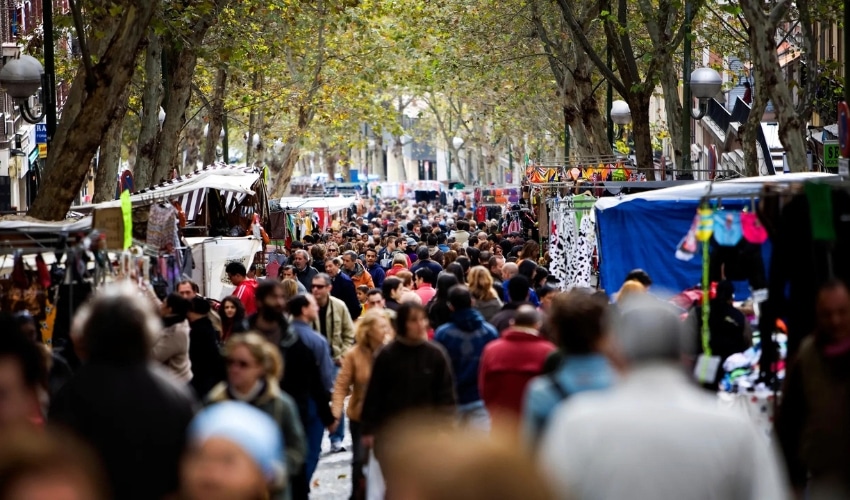
El Rastro’s street market runs on Sundays and public holidays from 9am to 3pm. Its main axis is Ribera de Curtidores, beside Plaza de Cascorro. You can browse without buying and combine the stalls with local shops, which have their own opening hours.
For a first visit, start at Cascorro and walk down Ribera de Curtidores, leaving time for side streets. You do not need to see everything: decide whether clothing, books, collectables or antiques interest you most.
Table of Contents
Opening hours: Sundays and public holidays
The Madrid City Council confirms the 9am–3pm timetable. As a planning suggestion, arrive around 9:30–10am to give yourself time; this does not guarantee quiet streets. Allow roughly 90 minutes to two hours for an initial walk, longer if you want to browse shops at leisure.
On weekdays, shops, antique dealers and galleries open according to their individual schedules, but the same street market does not take place. Events called “Los Sábados del Rastro” have separate programmes: check the specific announcement before planning a Saturday visit.
Getting there by Metro or Cercanías
| Station | Line | Suggested approach |
|---|---|---|
| La Latina | Metro 5 | An option for starting at Cascorro. |
| Tirso de Molina | Metro 1 | Walk towards Cascorro, then continue through the market. |
| Embajadores | Metro 3 and Cercanías C5 | Useful for entering or leaving at the lower end of the route. |
These are the connections listed by the city council. Check disruption for your travel day and working lifts if you need step-free access. Our Madrid Metro guide helps you plan the journey.
We recommend public transport for this walk: market days involve road closures and parking restrictions. Confirm an accessible pickup point instead of assuming a vehicle can meet you among the stalls.
A simple walking route
- Plaza de Cascorro. Use the square as your meeting point and starting place.
- Ribera de Curtidores. Follow the main street and choose the side streets that interest you.
- Calle de San Cayetano. Explore this area associated with painters, art and painting supplies.
- Galerías Piquer. At Ribera de Curtidores 29, you will find antique shops. Check opening times if they are the main reason for your visit.
- Plaza del Campillo del Mundo Nuevo. Finish around the area associated with trading cards, magazines and old books.
This is a flexible suggestion, not a booked guided tour or a timed route. Use the official cultural map to locate the streets. Ribera de Curtidores slopes: if using a wheelchair or pushchair, or if you have reduced mobility, adapt the distance and do not assume every access will be easy in crowds.
What to buy and how to choose
The neighbourhood and market offer clothing, books, records, second-hand objects, crafts and antiques. Stock can change from week to week. For a particular purchase, note measurements, your budget and how you will transport it.
- Inspect the item and ask about defects before paying.
- Confirm the price and payment method. Some cash can be useful, but sellers have different arrangements.
- Politely ask whether the price is negotiable. Bargaining is neither compulsory nor a guarantee of a discount.
- For bulky or valuable purchases, clarify delivery, proof of purchase and terms before agreeing.
Where to stop for food
Look for nearby bars or restaurants. The street market should not be described as rows of tapas or sushi stalls: the council’s permitted-products information excludes food for human consumption from its market stalls. Check the menu, prices and availability at your chosen venue.
Practical tips for your walk
Wear comfortable shoes and bring water and weather-appropriate protection. Keep your bag closed and phone secure in crowded areas. Agree on a meeting point if visiting as a group, and ask permission before photographing someone or their stall up close. These are practical precautions, not grounds for general accusations against sellers.
Why is it called El Rastro?
The traditional explanation connects the name with the old slaughterhouses and the trail left when cattle carcasses were moved. Madrid’s tourism office documents the market from 1740: its origins should not be placed in the early twentieth century or its name derived from “rasca”. The continuity of trades, shops and reused objects is part of the neighbourhood’s appeal.
Fit it into your Madrid itinerary
For a weekend visit, keep Sunday morning for the market and plan the rest with our two-day Madrid itinerary. If your trip does not include a Sunday or public holiday, browse the neighbourhood’s shops or see our Madrid shopping-centre guide for a different shopping experience.
Official sources checked on 20 October 2026. Confirm individual businesses’ hours and special events for your visit date.